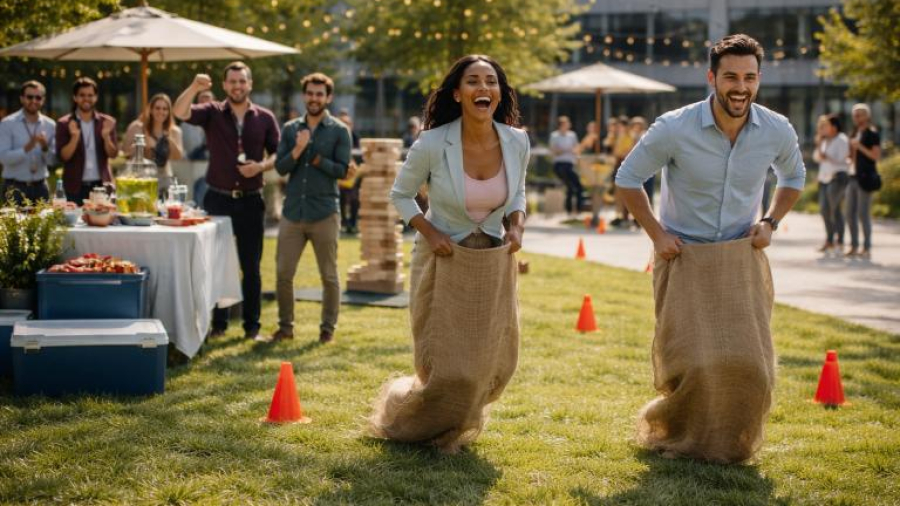
Most corporate events have the same issue.
Everything looks right on paper, the venue and the food and drinks are sorted, but once people arrive it becomes clear something’s missing. Small groups form, conversations stay within these same groups, and the overall energy never quite lifts.
The difference between an average event and one people actually remember usually comes down to one thing: interaction.
Because in a workplace setting often people don’t naturally mix. Departments stick together, familiar conversations dominate and unless there’s something actively bringing people together many of us won’t really engage with new people. And new social connections don’t develop by just standing around, they happen when people are doing something together, even something simple.
That’s where interactive entertainment comes in.
The best corporate event entertainment isn’t passive. It gives people a reason to connect and interact naturally, without forcing it.
Below are some of the most effective corporate event entertainment ideas that consistently get people involved and create a better overall experience.
Play Crowd-Favourite Games
These are the activities that tend to drive the most engagement early. They’re easy to join, require little explanation, and immediately give people something to do — which is critical in the first 30–60 minutes of a corporate event.
1. Mini Golf
Mini golf is one of the most reliable interactive entertainment options for a corporate event because it creates movement and conversation without putting pressure on people.
Instead of standing in one place, people move through the course in small groups, naturally interacting as they go. It’s structured enough to keep things flowing, but relaxed enough that it doesn’t feel like a formal activity.
What makes it particularly effective is how inclusive it is. You don’t need any prior experience, and it suits a wide mix of personalities — from competitive players to those who just want something casual to engage with.
From a team-building perspective, it encourages small group interaction and light competition. People end up talking, joking, and engaging in a way that wouldn’t happen if they were just standing around.
2. Sumo Suits
Sumo suits are one of those activities that instantly change the tone of a corporate event.
They’re visual, a bit unexpected, and naturally draw a crowd. While only two people compete at a time, the real interaction happens around the game — people watching, reacting, laughing, and waiting for their turn.
That’s what makes them effective as interactive entertainment.
They create shared moments. People who wouldn’t normally step forward end up getting involved, and even those who don’t participate directly are still part of the experience.
From a team-building perspective, it helps break down formality. It’s hard to maintain workplace hierarchy when someone’s bouncing around in a sumo suit. That shift creates a more relaxed environment where people feel more comfortable engaging with each other.
Lawn Games
Giant lawn games are some of the most effective tools for keeping a corporate event engaging over time.
Unlike high-energy activities that peak early, these create ongoing interaction throughout the event. People can step in, play for a few minutes, step out, and return later — which makes them ideal for maintaining flow without forcing participation.
They also create natural gathering points. Instead of people clustering in isolated groups, they gather around games, interact, rotate, and move between different areas.
That flexibility is what makes them so valuable.
3. Giant Jenga
Giant Jenga is simple, but it consistently draws attention.
People gather around, take turns, and as the tower gets higher, the tension builds. That shared anticipation — and the inevitable collapse — creates moments that everyone reacts to.
It’s not just the players who are involved. It becomes a group experience.
From a corporate event perspective, that’s exactly what you want. It encourages people to gather, interact, and share the moment, even if they’re not actively playing.
4. Cornhole (Bean Bag Toss)
Cornhole works well because it sits right in the middle of social and competitive.
It’s easy to understand, quick to play, and naturally works in pairs or small teams. People can step in for a round, then rotate out, which keeps the activity moving and prevents bottlenecks.
At a corporate event, this creates ongoing engagement. There’s always someone playing, someone watching, and someone waiting to jump in.
It also encourages casual competition between teams or departments, which helps drive interaction without making it feel overly structured.
5. Croquet
Croquet brings a slower, more relaxed dynamic to the event, which is just as important as high-energy activities.
It allows multiple people to play at once, and because of its pace, it encourages conversation while playing. People aren’t rushing — they’re interacting.
This makes it particularly useful for balancing the overall event. Not everyone wants something loud or fast-paced, and croquet provides an option that still supports engagement in a more relaxed way.
6. Bocce
Bocce is one of the most naturally social games you can include at a corporate event.
It’s simple, but it requires just enough strategy to get people talking and working together. Teams take turns, discuss positioning, and react to each other’s plays.
That interaction is what makes it effective.
It works especially well in outdoor settings where people can gather around, watch, and join in casually. Over time, it becomes part of the overall flow of the event rather than a standalone activity.
Social & Interactive Experiences
Not everything at a corporate event needs to be a game to be interactive.
Some of the most effective entertainment comes from experiences that encourage people to gather, participate in small groups, and create something — whether that’s a photo, a shared moment, or just a reason to engage.
These elements are often what keep the event flowing between the bigger activities.
7. Photo Booths (Instant Prints & Digital Sharing)
Photo booths are one of the most consistently used features at corporate events — and for good reason.
They give people a clear, simple reason to interact. Small groups gather, choose props, take photos, and immediately get something back — either a printed photo or a digital version they can share.
That interaction happens naturally.
People who might not jump into games will still participate in a photo booth. It feels low-pressure, quick, and social. And once one group starts, others follow.
From a team-building perspective, it creates shared moments between colleagues who might not normally interact. It also gives people something to take away from the event, which reinforces the experience long after it’s finished.
8. Trivia Quiz
Trivia is a great way to bring structure into a corporate event without making it feel overly formal.
They work particularly well for larger groups where you want to bring everyone together at a certain point, rather than relying entirely on free-flow activities.
Teams collaborate, discuss answers, and engage in light competition — which naturally encourages communication and interaction across the group.
The key is keeping it accessible and well-paced. When done right, trivia becomes less about getting the answers right and more about the shared experience of participating together.
It’s especially effective for balancing the event — giving people a moment to regroup, engage collectively, and then return to more casual interactions.
How to Structure Your Event for Maximum Interaction
Even the best entertainment ideas won’t work if the event isn’t set up properly.
The goal isn’t to fill the space with activities — it’s to create an environment where interaction happens naturally.
That comes down to how everything is structured.
Start by thinking in terms of zones rather than a single focal point. If everything is happening in one area, people gather, but they don’t move. When you create multiple points of interest, people circulate.
A strong setup usually includes:
- one or two high-engagement activities (like mini golf or sumo suits)
- several social, ongoing games (like lawn games)
- and a few interactive experiences (like photo booths or drink stations)
That mix allows people to move between different types of interaction depending on their personality and energy level.
It’s also important to keep everything easy to join. If people have to wait too long, figure out complicated rules, or feel like they’re interrupting something, they simply won’t participate.
The more accessible the activity, the more effective it becomes.
Add a Comment